
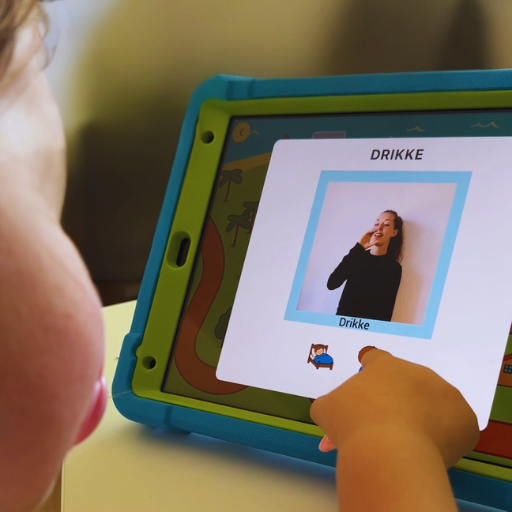
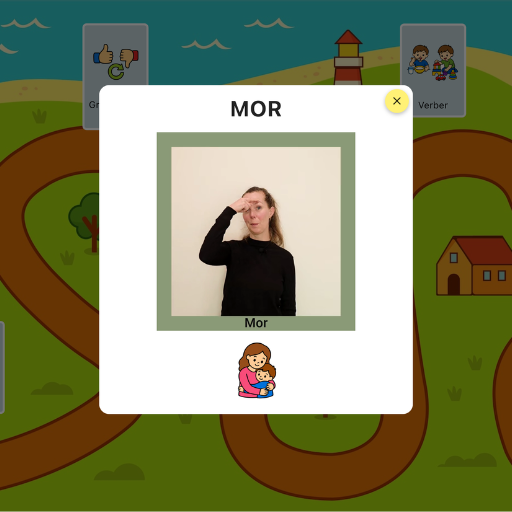
TalkiHand as a special educational tool
TalkiHand is developed for children who need extra support, repetition, and time to develop language and communication. The app can serve as a targeted learning tool in special education and be adapted to both the child’s level, interests, and current goals.

When repetition makes the difference
That is how long it would take to achieve the same language exposure as an 18-month-old child if the child only sees their AAC system used 2 × 30 minutes a week.¹
¹: Illustrative calculation after Jane Korsten, 2009
signs that can be trained and learned in TalkiHand
opportunities for repetition at the child’s own pace
From educational goals to practical training
TalkiHand can be adapted to the individual child’s current goals, vocabulary, and developmental level. Among other things, the app can support work with:
Language skills
Word comprehension, concept formation, sign and symbol recognition, and vocabulary expansion.
Operational skills
Cause-and-effect, hand-eye coordination, targeted activation, and choosing between multiple options.
Communication skills
Use of multiple forms of communication and transferring learned words to the child’s overall communication.
Motivation and mastery
Attention, perseverance, independence, and the experience of: I can do it myself.
This material is intended as inspiration for individual goal setting and is not a standardized assessment tool.
The level of difficulty follows the child
From the first steps toward language to more complex linguistic choices.

01
First steps toward language
At an early developmental stage, the child can see signs and symbols repeatedly without any requirement to respond. Later, the child can begin to direct the activity and work on cause-and-effect and targeted pressing.

02
Expanding the vocabulary
When the child begins to understand and use their first signs and symbols, they can practice recognition and choosing between multiple options. New words can be introduced gradually, allowing the child to independently explore signs and symbols in their vocabulary.

03
Early literacy
When the child can handle more information on screen, the activities can be made more complex. TalkiHand can be used, among other things, to work with letters, sounds, and signs, and later to build connections between signs, symbols, and written words.
More practice — without more adult supervision
Many children need numerous repetitions to learn and retain new language skills. TalkiHand enables short, frequent practice sessions, even when an adult cannot sit right beside them.
The child can practice independently
Familiar activities can gradually be completed with less support from an adult.
Practice can fit into daily life
For example, the child can work on their vocabulary while the family prepares dinner or manages other daily tasks.
Independence and self-confidence
When the child succeeds in activities on their own, it can boost self-confidence, motivation, and the desire to keep learning.
Together for the child’s language
What the child learns in TalkiHand extends beyond the app. Therefore, vocabulary can be shared and used across all the people and environments in the child’s daily life.
A shared vocabulary
Professionals and families can work with the same focus words and supplement with words that are particularly relevant to the child’s own life.
From practice to everyday life
Words and signs from TalkiHand can be used further in the child’s signing, speech, AAC, and natural communication situations.
The family as a communication partner
TalkiHand can handle part of the structured repetition, allowing the family to focus primarily on using language together with the child in daily life.
